Technical questions about Dedots
Everything you want to know about Dedots, the 3D dots on wire mesh that turn facades, fences and walls into images. Read how Dedots is used for facades, fences, walls and ceilings, how any image becomes a dot design, and how it is made and mounted. Is your question not listed? Download the product catalogue or contact us.
Downloads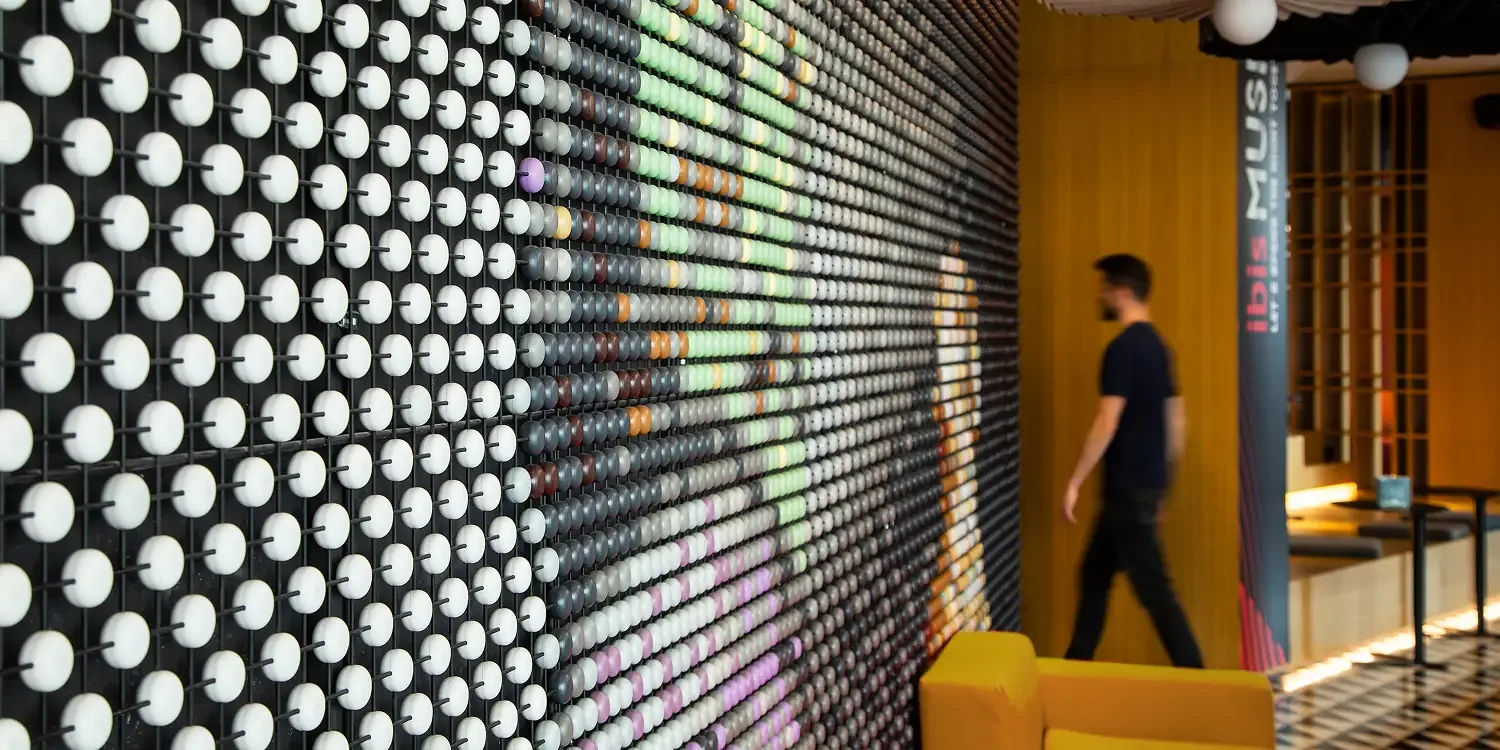
What is Dedots?
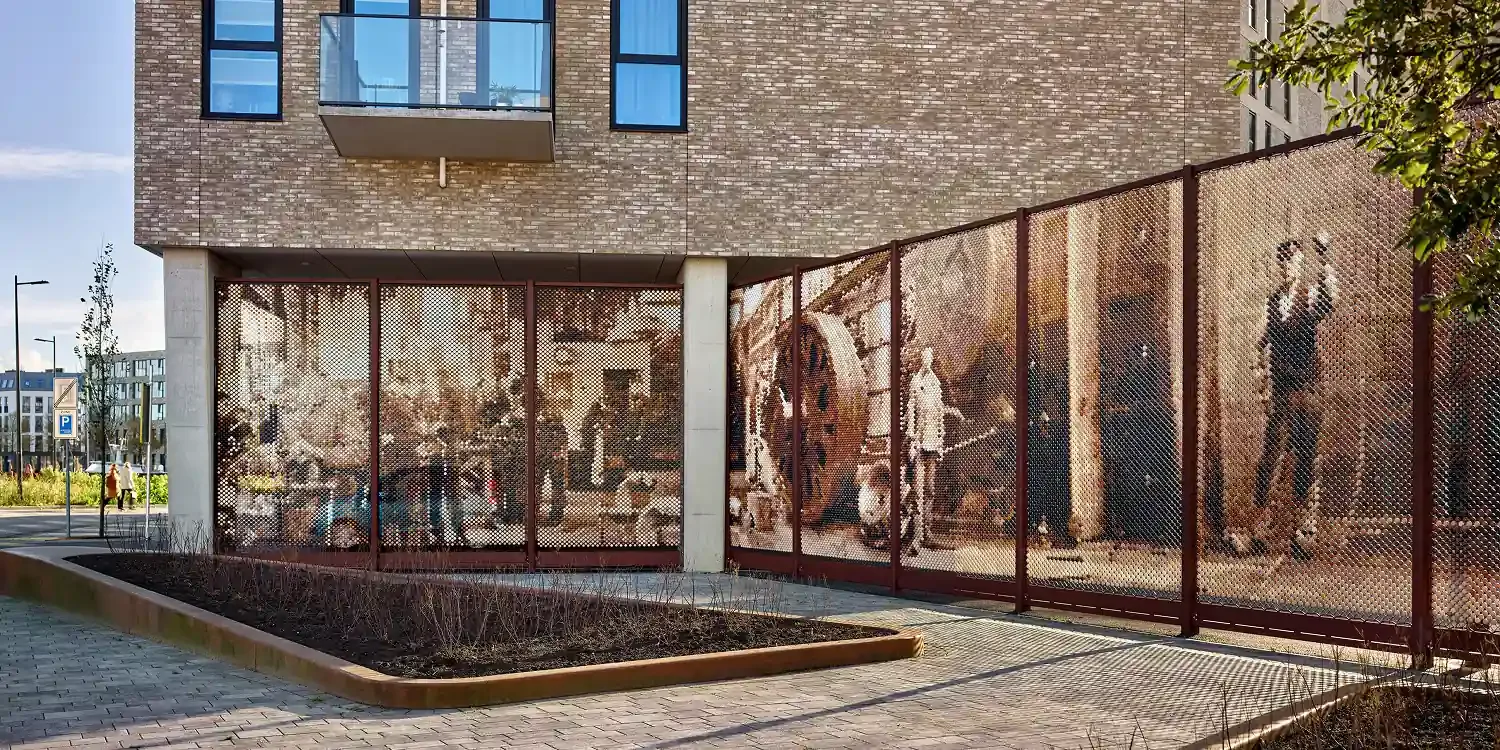
Dedots is a modular system of colourful 3D dots fixed on steel mesh panels, designed and produced by Redfort Fabrics. Like pixels, the dots form graphics, patterns or complete artworks, turning a facade, fence, wall, ceiling or railing into an expressive canvas.
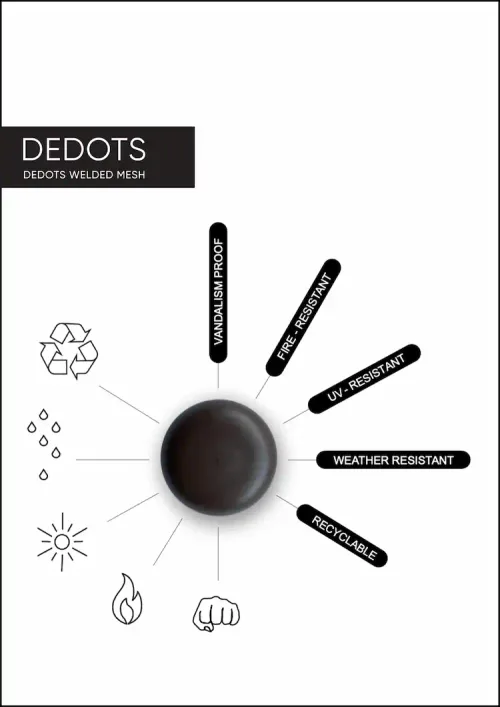
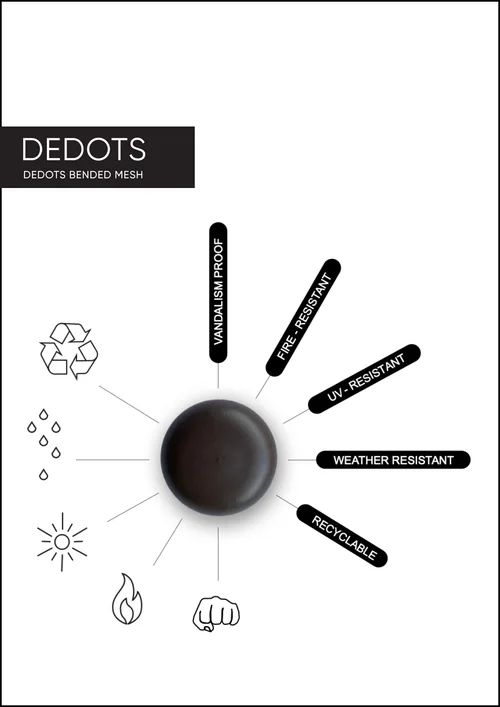
It is used as a creative facade screen, decorative enclosure, noise barrier, room divider or acoustic wall panel. Dedots is durable, recyclable and resistant to UV, fire and vandalism. There are 77 standard colours, custom shades on request, and projects start from 150 m².
Can any image or design be made with Dedots?
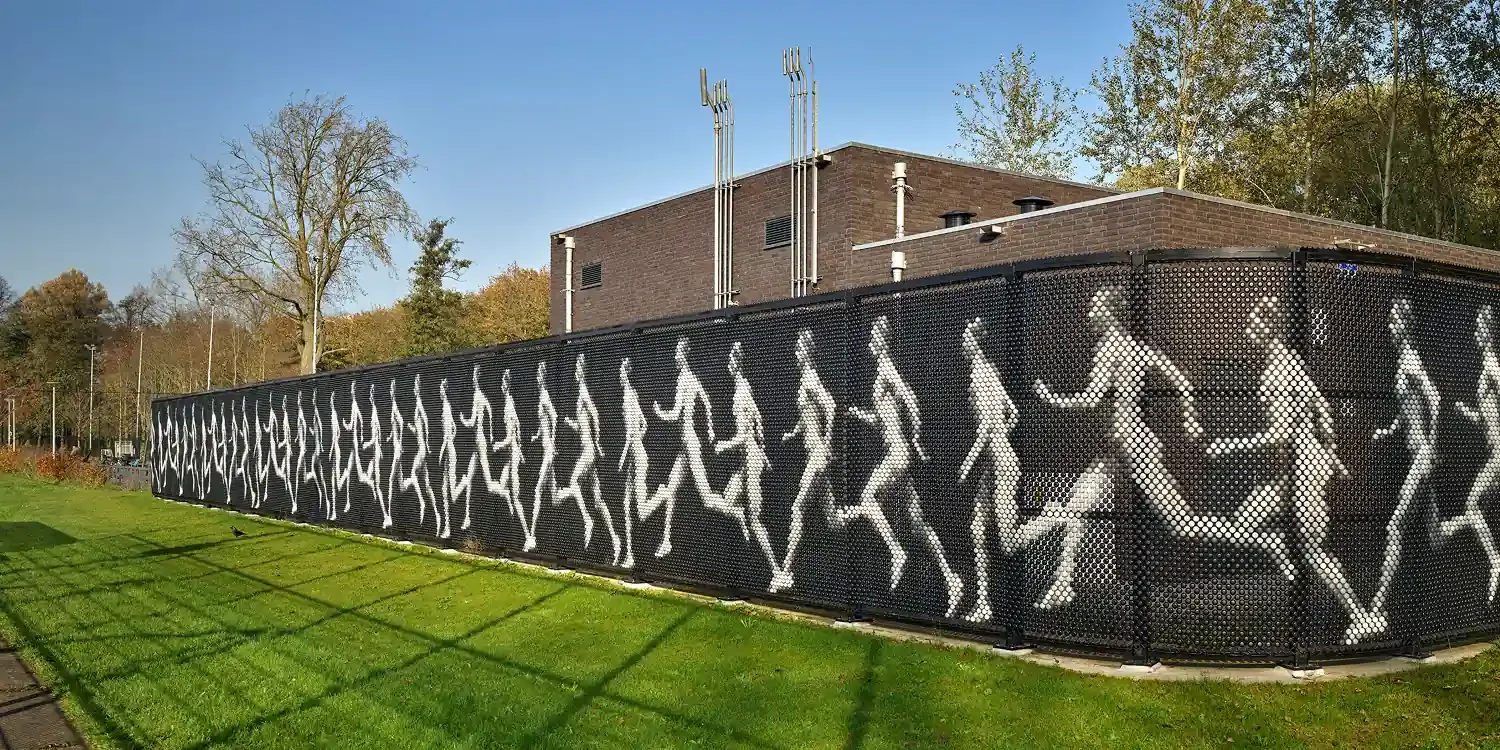
Yes. Any image, pattern or graphic design can be turned into Dedots, and Redfort guides the design process. Examples are a Rembrandt portrait in Amsterdam, Delft blue in Delft and a 60 metre city tableau on a noise barrier in Dordrecht.
What are the possibilities with Dedots?
Every Dedots project is tailor made. Any image, logo or pattern can be translated into dots, in 77 standard colours or custom shades, from dense to transparent. Patterns can reflect local culture or brand identity, and in sport clubs show their logos, colours or heroes.
Dedots works indoors and outdoors, as panels for facades, fences, walls, ceilings and railings, with special finishes such as copper or chrome.
What can Dedots be used for?
Dedots works indoors and outdoors and improves safety, wayfinding and privacy. As an enclosure it reduces wind and withstands high impact, and for gates the panels are UV stable and vandal resistant.
Because it is two sided, Dedots makes a light room divider. On a facade it allows natural ventilation, and ceiling and wall panels improve the acoustics.
Nets span large distances without substructure, and as a railing Dedots prevents climbing and meets EU standards.
Where has Dedots been used?
In hotels, public spaces, sports parks and infrastructure worldwide, such as the 265,000 copper dots in the SiR Victor hotel in Barcelona, the flying birds in the National Museum of Scotland and the parking facade of AVE Santa Clara in California.
Browse projects by sector, such as hospitality, public spaces, sport, infrastructure, offices, retail and housing.
How does transparency work with Dedots?
Transparency comes from patterns, gradients or open areas, so you can control light, view and wind. A diamond pattern facade reduces direct sunlight by 35%, and an enclosure for a sports park near Rotterdam reduces the wind on the field by 40%.
Which colours are available?
There are 77 standard colours, and custom shades can be developed on request. The dots are coloured all the way through. Special finishes are possible too, such as copper dots or a chrome finish.
What is Dedots made of and is it recyclable?
Dedots is made of PC-ASA, a highly reusable thermoplastic. Through our return programme we recycle 96% of our products. The Dotted Sequences installation was even made from more than 56,500 recycled dots.
How strong and vandal resistant is Dedots?
Thanks to the high tensile strength and the irreversible internal lock, Dedots withstands intensive use. On the noise barrier in Dordrecht the dot pattern even helps against graffiti.
Can Dedots be used outdoors?
Yes. Dedots performs in all weather conditions and has an F1 classification according to the UL746C test. A UV blocker keeps the colours bright outdoors.
Is Dedots fire resistant?
Yes. Dedots has the best possible classification for fire resistance, as tested according to the UL94 standard.
Does Dedots improve acoustics?
Yes. Dedots ceiling and wall panels give a significant acoustic improvement, which is why they are used in lobbies, restaurants and offices.
How is Dedots mounted?
Chain link mesh needs a substructure for tension, on a steel structure for large surfaces or in a steel frame for railings and room dividers. Welded mesh of 4 mm steel rods forms a stiff panel. With special mounting clips the panels connect seamlessly into one surface.
How does a Dedots project with Redfort work?
From imagination to realisation, Redfort guides the creative process together with you. We translate your image or idea into a Dedots design and choose the colours, the density and the mounting that suit your project. Contact us with your idea or start with the product catalogue.
Does Redfort deliver Dedots internationally?
Yes. Redfort Fabrics is based in Breda, the Netherlands, and produces in its own facility in Bangalore, India. Dedots projects have been realised across Europe and in the United States, from Barcelona, Amsterdam and Edinburgh to New York and Santa Clara.
For shipping to your country, contact us. Redfort has contact addresses for Europe, America, Asia, Africa and Australia.
Who makes Dedots?
Dedots is made by Redfort Fabrics, born from the Dutch design studio Demakersvan, founded in 2008. Production takes place in its own facility in Bangalore, India, where all employees receive training, social security and a pension. In 2009 this earned Redfort the Toon van Tuijl Design Award. Read more on About us.
Where can I find the catalogue and datasheets?
Download the Dedots product catalogue, project sheets and datasheets below or on the downloads page.